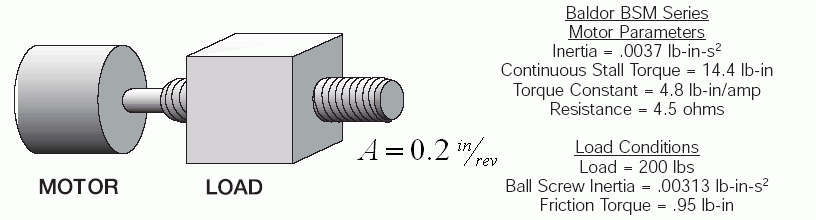
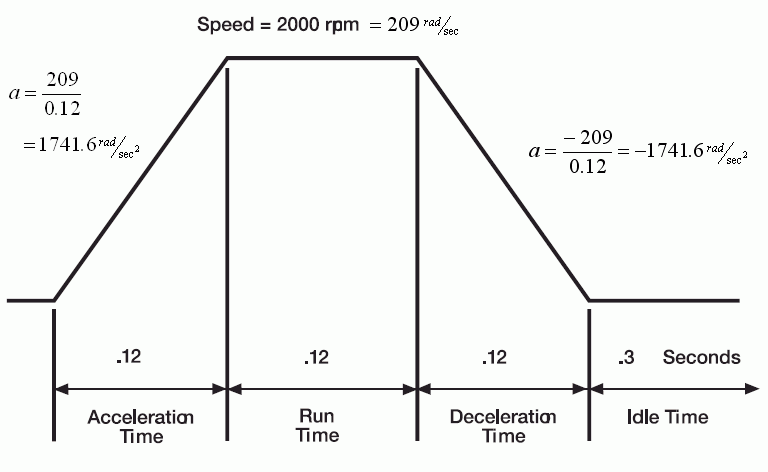
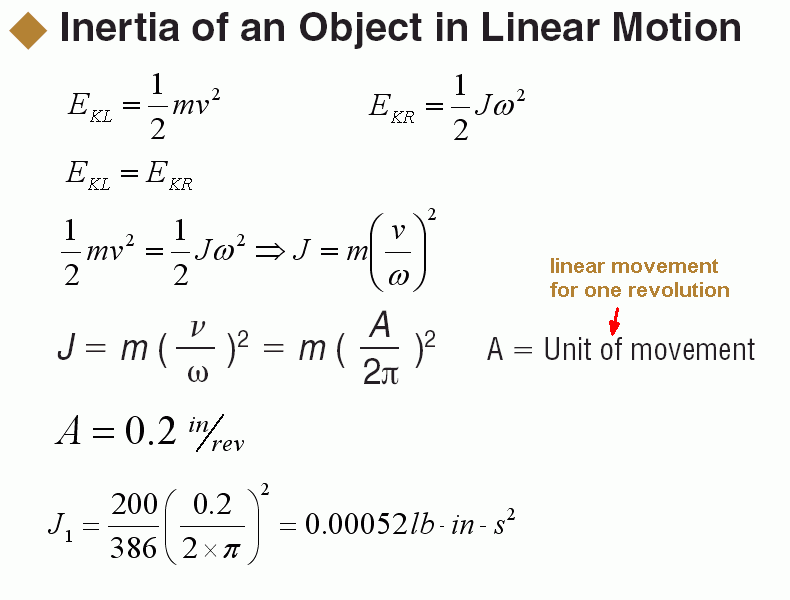
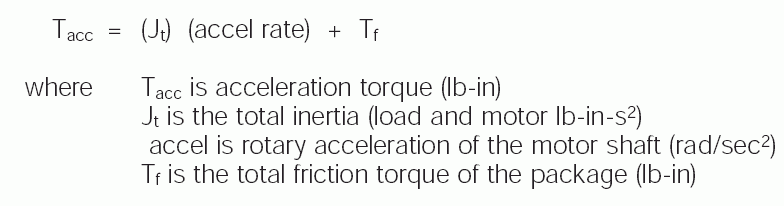
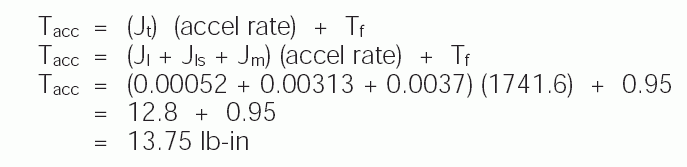
The motor must be capable of providing torque to accelerate the entire mechanics of the load (friction plus inertia), as well as torque to move itself. In this example, the motor must be capable of supplying a total acceleration torque of 13.75 lb-in.
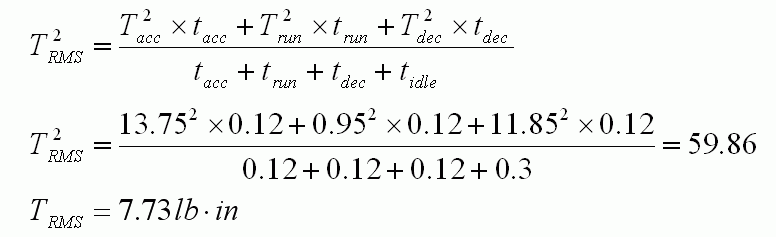
Torque Over the Duty Cycle
The motor must also be capable of providing a certain amount of torque
continuously over the duty cycle, or move profile as was defined earlier. In
order to determine this, we must look at the rest of the move profile and
determine the torques associated with them.
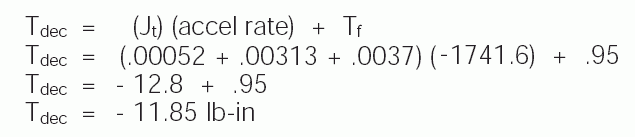
During the stopping cycle, or deceleration, the torque required is:

Control Section
The next step is to determine requirements for a suitable control (amplifier).
The control must be able to supply sufficient acceleration current (for the
application’s acceleration requirements), as well as continuous current (or
“RMS” current for the application’s duty cycle requirements).
Acceleration current which must be supplied to the motor is calculated from:
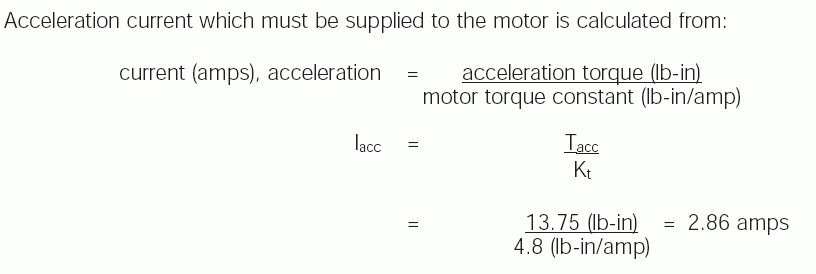
RMS current over the duty cycle, which the control must be capable of supplying to the motor, is calculated from:
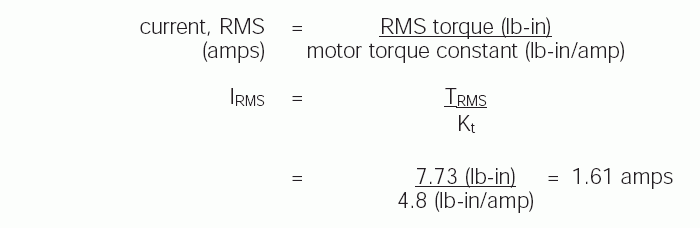
Thus the servo control which would be selected must have the capability of supplying currents of 2.86 amps for acceleration and 1.16 amps continuously (RMS over the duty cycle).